
Pad Printing
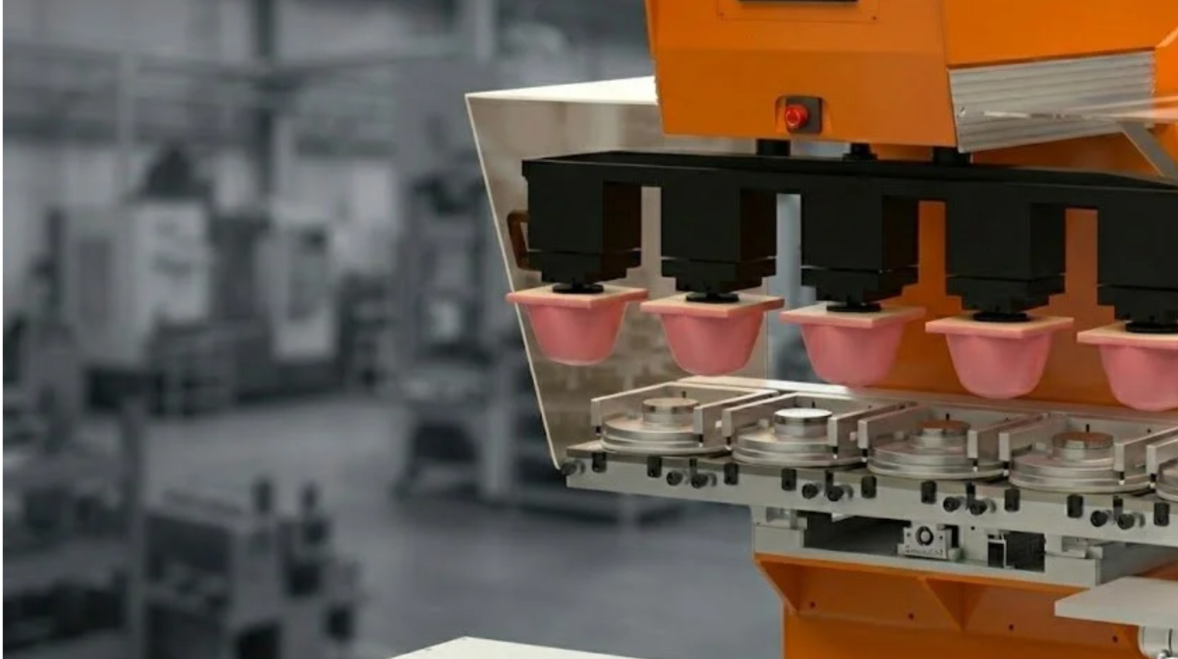
Printing process used to transfer detailed graphics, logos, and markings onto surfaces that are difficult to print using traditional flat printing methods. Using a flexible silicone pad, the process adapts to curved, textured, recessed, and irregular geometries while maintaining sharp detail and accurate positioning.
From Cliché to Finished Part
Four steps stand between an image file and a printed, cured part — each one holds the registration that keeps colors and detail sharp.
Cliché Preparation
The image is etched as a shallow recess in a steel or polymer plate, ink will later sit only in that cavity.
Ink Pickup
A doctor blade sweeps across the plate, wiping it clean and leaving ink only inside the etched cavity.
Pad Transfer
The silicone pad lifts the ink off the plate, then flexes to match the part's contour as it deposits the image.
Multi-Pass Registration
Additional colors are added pass by pass, each one aligned to the same registration point as the last.
Multi-Color Precision Printing
Pad printing supports high-opacity logos and detailed multi-color graphics across a wide range of ink systems, chosen by durability, surface type, and exposure. Colors stay clear and consistent even under handling, friction, and repeated use.
Vibrant Multi-Color Graphics
Each color is printed from its own cliché and registered pass to pass, whether the job calls for single- or two-component ink, keeping multi-color logos sharp and consistently placed.
High-Opacity Printing
Full coverage in a single pass on dark or transparent surfaces, formulated as air-drying or oven-curing systems depending on the substrate and required opacity.
Abrasion-Resistant Inks
Two-component inks cross-link during curing for maximum wear resistance — the standard choice for cosmetic packaging, sport equipment, and frequently handled parts.
Surface & Texture Adaptation
Ink flexibility and cure method are matched to the surface — coated, textured, or untreated — so the finish bonds properly instead of just sitting on top.
Metallic & Technical Finishes
Premium metallic pigments and technical-grade finishes, including UV-curing systems for the sharp edges and fast turnaround certain applications need.
Printing on Complex Geometries
Pad printing transfers detailed graphics onto surfaces flat processes can't reach. Flexible silicone pads press into curves, recesses, textures, and changing angles while keeping ink transfer controlled and detail sharp.
Curved Surface Printing
Clean graphic transfer onto curved and convex surfaces, used for bottles, tubes, and cylindrical housings.
Recessed & Cavity Printing
Pads reach into cavities and stepped contours, ideal for switch housings, molded parts, and tool bodies.
Multi-Angle Detail Printing
Consistent registration across changing angles and faces, applied to tools, hardware, and sporting equipment.
Material Compatibility
Pad printing bonds to a wide range of substrates — from engineering plastics to metal, glass, rubber, and natural materials — with the ink system matched to each one for lasting adhesion.
Rigid & Engineering Plastics
Polycarbonate, ABS, PMMA, polystyrene, polyamide, and polyacetal all take pad printing ink reliably, with the ink system matched to the specific resin and finish.
Flexible & Semi-Rigid Plastics
PVC (rigid and plasticized), polyester, polyurethane, and pre-treated polyethylene or polypropylene — flexible substrates need an ink that moves with the part without cracking or lifting.
Glass, Ceramics & Duroplastics
Bottles, glassware, ceramic housewares, and duroplastic components hold ink cleanly with the right adhesion system — from cosmetic glass to compact discs.
Metals & Pre-Coated Surfaces
Aluminum, steel, and painted or powder-coated parts bond well with pad printing ink — standard on tools, hardware, appliances, and industrial components.
Rubber, TPE & Silicone
Rubber, thermoplastic elastomers, synthetic leather, and silicone rubber each need a specific ink chemistry to flex with the material and resist cracking over time.
Wood, Leather & Textiles
Natural and organic surfaces — wood, leather, and textiles — print cleanly with ink systems suited to porous and fibrous materials.